Give MeJapan
Where to stay

See a Japanese Fireworks Festival From Your Hotel Room — in Atami, Year-Round

Most fireworks festivals in Japan happen once a year, in summer, and mean standing in an enormous crowd. Atami holds them across all four seasons, an hour from Tokyo, and you can watch from your room. Here is how the hotels sit relative to the launch site.

Updated 2026-08-27

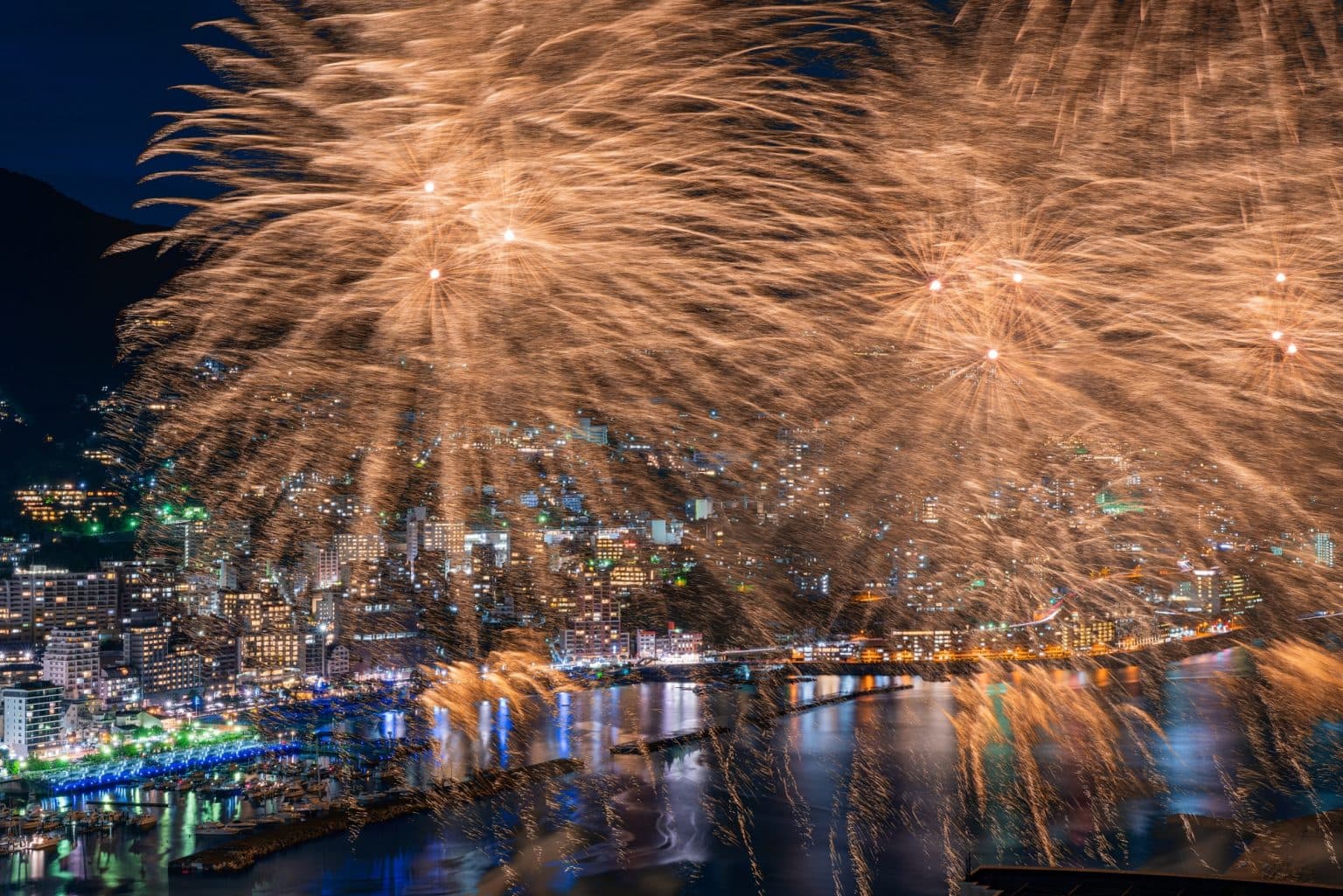
Two things about Japanese fireworks surprise almost every visitor. The first is that hanabi taikai are not really about the fireworks alone — they are enormous public events, and the standard experience involves arriving hours early, sitting on a tarpaulin, and queueing to get home afterwards on a train packed past the point of comfort. The second is that nearly all of them happen in a narrow summer window, which is also when Japan is hottest and most crowded. Atami breaks both rules. It stages around fifteen displays a year — fifteen in 2026 — spread across spring, summer, autumn and winter, and the town is built up a steep bowl around the bay they are launched into, which means the hotels look directly down at the launch site. You can watch a full display from your own room, or from an open-air hot spring bath, with no crowd and no journey home. Atami is also under an hour from Tokyo Station by Shinkansen, so this works as a single overnight trip. What decides your experience is where your hotel sits on the bay, so this guide sorts them by exactly that. Dates and launch positions change from year to year, so check the official schedule before booking anything.

How to choose

Why Atami is different: around 15 displays a year, in every season
Most Japanese fireworks festivals are held once a year, in July or August. Atami stages roughly fifteen displays a year, spread across all four seasons. For a visitor this changes the planning entirely: instead of forcing your whole trip into the hottest, busiest weeks of the Japanese calendar to catch a single event, you pick a comfortable season and find a date that fits. Displays are usually held on Sundays and public holidays, which makes them easier to build a weekend around. Winter dates have the clearest air of the year and the smallest crowds, and are the ones most visitors never realise exist.
The 2026 dates, and how to find next year's
The 2026 schedule runs to fifteen displays: 26 April and 24 May in spring; 20 and 26 July and 5, 9, 18 and 24 August in summer; 13 September, 12 and 25 October, 8 and 23 November in autumn; and 6 and 25 December in winter — the last of these falling on Christmas Day. Displays normally run 20:20–20:40, with the July and August ones starting slightly earlier at 20:15. They are launched over Atami Bay, from the quay area near the port. Dates change every year and are typically announced around late November for the following year, so if you are planning further ahead, check the Atami city tourism site for the current schedule rather than assuming this pattern repeats exactly.
The launch site is fixed — everything depends on your hotel's position
The fireworks are launched from the sea just off Atami's Sun Beach and Shinsui Park, near the waterfront below the station. Atami Bay is a natural bowl, enclosed by hills on three sides, and the hotels are built up those slopes facing the water. So one decision drives everything: do you want to be close and low, or further back and high? Waterfront hotels near the launch site put the shells directly overhead — loud, physical, filling your window. Hilltop hotels look down on the whole bay, so you see the full display reflected in the water with the town lights around it. Both are good; they are simply different experiences.
You must book a sea-facing room — this is the one thing to get right
A hotel being in Atami does not mean your room faces the fireworks. Most of these properties have rooms on both sides of the building, and an inland-facing room sees nothing at all. When booking, look specifically for a sea-view or ocean-view room type rather than the cheapest available rate. Floor height matters too, since lower floors can be blocked by buildings closer to the water. If you want certainty, some hotels sell dedicated fireworks-night plans that guarantee a viewing room. This is the single most common way visitors end up disappointed, and it is entirely avoidable.
Check whether the view is from the room, the bath, or a shared terrace
Hotels here differ in where you can actually watch from. Some offer the view from guest rooms. Others have a rooftop terrace, a large public bath, or an open-air onsen facing the bay — which means soaking in hot spring water while the display goes off in front of you, an experience worth planning for deliberately. A few offer all three. Decide which you want before comparing hotels: if the plan is to watch from the bath, a sea-facing room matters less, and vice versa. Note that public baths are gender-segregated and bathed in naked, so a shared terrace may suit couples and families better.
Fireworks nights cost more and sell out early
Sea-facing rooms on display nights are the most expensive rooms of the year at these hotels, and they book out well ahead — often as soon as the annual schedule is announced. If a specific date matters to you, reserve early and expect to pay a premium over the same room on an ordinary weekday. The reverse is also useful to know: outside display nights, Atami is an inexpensive place to stay midweek, and the sea views and hot springs are exactly the same. If the fireworks are a bonus rather than the point of the trip, book a normal night and save meaningfully.

Atami hotels, sorted by where they sit relative to the fireworks

1

Higashi-Kaigan-cho · waterfront, facing the launch site

Atami Pearl Star Hotel

熱海パールスターホテル

Position: on the seafront, looking straight at the fireworks. This is the pick if your main worry is booking a room and then not being able to see anything, because it is the most explicit hotel here about where you can watch from — sea-facing guest rooms, a sixth-floor terrace, and an infinity bath set above a reflecting pool, all facing the bay. That means you can watch from your room, from a shared terrace, or from the water, and choose on the night. It sits on the east coast road close to the launch point, so the display is head-on rather than distant. Reviewers on Japanese booking sites rate it around 4.6 out of 5, among the highest in town. It is expensive and small, so book early.

What makes it special

  • +States clearly that rooms, terrace and the infinity bath all face the fireworks
  • +Close to the launch site for a head-on view
  • +Around 4.6/5 with domestic reviewers — the highest here

Good to know

  • The most expensive option alongside Grandbach
  • Few rooms, so display nights sell out very early
2

Nishikigaura · on a headland at the south end of the bay

Hotel New Akao

ホテルニューアカオ

Position: out on a cliff headland, looking back across the water. The reason this ranks high for overseas visitors is simple: all 352 rooms face the ocean, so the usual gamble over room orientation disappears entirely. Book any room and you are facing the bay. The hotel is built on the Nishikigaura promontory, effectively projecting into the sea, which gives it an unusually open outlook — the display reads as a wide panorama over the water rather than something directly overhead. It is a large resort with plenty of indoor facilities, which helps if the weather turns. The trade-off is distance: you are further from the launch point than the waterfront hotels, so you lose some of the physical impact.

What makes it special

  • +All 352 rooms are ocean-facing — no room-orientation risk
  • +Dramatic clifftop setting projecting into the bay
  • +Large resort with substantial indoor facilities

Good to know

  • Further from the launch site, so less of the overhead impact
  • Busy and crowded during Japanese holiday periods
3

Wadahama · on the pier, closest to the launch site

Atami Korakuen Hotel

熱海後楽園ホテル

Position: the closest of the six, almost directly beneath the fireworks. Built out on the Korakuen pier at the harbour, this is where you go for sheer impact — the shells open close overhead, and because Atami Bay is a bowl ringed by hills, the sound comes back at you off the slopes. It is a large, long-established hotel with a wide sea-view public bath, so the hot-spring-plus-fireworks combination is available here too. What makes it stand out is value: it holds around 4.4 out of 5 across more than 3,000 domestic reviews while sitting at a considerably lower price point than the top two. If you want maximum drama without a luxury budget, start here — but confirm a sea-facing room.

What makes it special

  • +The closest hotel to the launch site — maximum impact
  • +Wide sea-view public bath overlooking the bay
  • +Notably cheaper than the higher-rated options, ~4.4/5 over 3,000+ reviews

Good to know

  • Only sea-facing rooms have the view — the room type matters
  • A large older hotel; facilities are functional rather than refined
4

Minaguchi-cho · hilltop above the town

Risonare Atami

リゾナーレ熱海

Position: high on the hillside, looking down over the entire bay. Part of Hoshino Resorts, which means a level of English-language service and international polish that most hotels in Atami do not offer — worth weighing if this is an early trip to Japan. The elevated position gives a panoramic view: you see the display below you, reflected in the water, framed by the lights of the town. It photographs better than any of the waterfront options. The hotel is strongly family-oriented, with activities and facilities aimed at children, so it suits a family night out rather than a romantic one. Rated around 4.5 out of 5 domestically. Because you are looking down from a distance, expect a beautiful view rather than a visceral one.

What makes it special

  • +Hoshino Resorts — reliable English-language service
  • +Panoramic elevated view over the bay, best for photographs
  • +Extensive children's facilities and activities

Good to know

  • Distant and elevated, so the display is a view rather than an experience
  • Requires a climb or shuttle from the station and waterfront
5

Izusan · hillside on the north side of the bay

Hotel Grandbach Atami Crescendo

ホテルグランバッハ熱海クレッシェンド

Position: high on the northern slope, overlooking the bay from above. The luxury choice, and the one to pick for a quiet, adult trip. Every room has its own hot spring bath, which changes the fireworks proposition entirely — you watch the display from your private open-air bath, with no shared space and no gender-segregated etiquette to navigate. That also sidesteps the tattoo question that applies to communal baths. It holds close to 4.8 out of 5 with domestic reviewers, the highest score in this guide, and the food is a significant part of what you are paying for. It is the most expensive option here and sits some distance from the launch site, so choose it for the setting and the privacy rather than for proximity.

What makes it special

  • +Private hot spring bath in every room — watch from your own bath
  • +Close to 4.8/5 domestically, the highest rating in this guide
  • +Quiet hillside setting suited to couples and special occasions

Good to know

  • The highest price of the six by a clear margin
  • Well back from the launch site — a distant, elevated view
6

Ginza-cho · town centre, five minutes' walk to the beach

Atami New Fujiya Hotel

熱海ニューフジヤホテル

Position: in the centre of town, a short walk from the waterfront viewing area. The budget option, and a genuinely useful one if the fireworks matter more than the room. It sits five minutes on foot from Sun Beach and Shinsui Park, so rather than relying on your window you can simply walk down and watch from the waterfront where the display is launched — then be back at the hotel within minutes, avoiding the packed trains that make most Japanese fireworks festivals exhausting. It is run by Itoen Hotels, whose model is buffet dining with unlimited drinks included, and rooms often come in around a third of the price of the top-rated options here. Reviews are more modest, at around 3.8 out of 5. Expect dated, functional accommodation at a price that makes the trip easy to justify.

What makes it special

  • +Five minutes' walk to the launch-side waterfront viewing area
  • +Buffet with unlimited drinks included at a very low nightly rate
  • +Central location, convenient for the station and town

Good to know

  • Dated facilities and the lowest review scores here (~3.8/5)
  • Room views vary considerably — do not count on watching from your window

Frequently asked questions

Q.Are Japanese fireworks really only in summer?
Almost everywhere else, yes — the great majority of hanabi taikai are held once a year, in July or August. Atami is the notable exception, staging around fifteen displays a year across all four seasons. In 2026 that means April and May in spring, July and August in summer, September through November in autumn, and two December dates including Christmas Day. This matters if you would rather not travel to Japan in the peak heat and crowds of August. Winter displays have the clearest air and the thinnest crowds of the year. Dates shift annually and are usually announced around late November for the following year, so check the current schedule before building a trip around one.
Q.Do I need to book a specific room to see the fireworks?
In most cases yes, and this is the mistake worth avoiding. These hotels have rooms on both sides of the building, and an inland-facing room will see nothing. Book a sea-view or ocean-view room type specifically, and check the floor, since lower floors can be blocked by buildings nearer the water. The exception is Hotel New Akao, where all 352 rooms face the sea. Some hotels also sell fireworks-night plans that guarantee a viewing room — the safest option if a particular date is the reason for your trip.
Q.Can I watch the fireworks from an onsen bath?
At several of these hotels, yes, and it is one of the better experiences Japan offers. Atami Pearl Star Hotel has an infinity bath facing the bay, Atami Korakuen Hotel has a wide sea-view public bath, and Hotel Grandbach Atami Crescendo has a private hot spring bath in every room. Note the difference: public baths are gender-segregated and bathed in naked, with tattoo restrictions applying at some properties, whereas a private in-room bath avoids both issues. If watching from the water is the plan, choose the hotel on that basis rather than on room orientation.
Q.Is it better to be close to the fireworks or high above them?
They are genuinely different experiences rather than better and worse. Waterfront hotels near the launch site — Atami Korakuen Hotel especially — put the shells almost overhead, and because the bay is enclosed by hills the sound reverberates back at you. Hilltop hotels such as Risonare Atami and Hotel Grandbach look down on the whole bay, so you see the display reflected in the water with the town lit up around it, which photographs far better. Choose proximity for impact and elevation for the view.
Q.How do I get to Atami from Tokyo?
Atami is roughly 40 to 50 minutes from Tokyo Station by Shinkansen, which makes it one of the easiest overnight trips from the city and even feasible as a long day trip. The station sits above the town, with the waterfront and launch area a downhill walk or short bus ride away. Hillside hotels generally run shuttles from the station. The short journey is a large part of why watching fireworks here is so much less taxing than at a major festival elsewhere — there is no multi-hour trip home afterwards in a crowd.
Q.How far ahead should I book?
As early as you can once the annual schedule is published. Sea-facing rooms on display nights are the most in-demand rooms of the year in Atami and are priced accordingly. If your trip is built around a specific date, treat the room as the thing to secure first. If the fireworks are optional, consider the opposite approach: book an ordinary midweek night, when the same sea views and hot springs cost substantially less, and treat any display that coincides as a bonus.